Screen Printing vs DTF: Which Makes More Sense at Different Quantities?
TLDR: Choose by repetition, not quantity alone
For screen printing vs DTF, start by counting how many garments use the exact same artwork. Screen printing is a strong candidate when one design will be repeated across a substantial run, especially if it uses a few solid colors. DTF is often the more flexible option for short runs, detailed full-color graphics, individual names, or orders split among many artwork variations.
There is no universal break-even quantity. The answer changes with the number of ink colors, garment type, print size, locations, design versions, production schedule, and supplier pricing. Colored polyester and performance garments add another variable: whichever method you choose should be tested for dye migration and material compatibility before the full order proceeds.
How screen printing and DTF differ
Screen printing pushes ink through a prepared mesh stencil onto the garment. In conventional multicolor production, each color is applied through a separate screen. That means a four-color design generally needs more preparation than a one-color design, including color separations, screens, registration, and press setup.
Once that setup is complete, the same design can be printed repeatedly in an efficient production sequence. This is why automated screen printing remains difficult to beat for sheer production volume, according to FESPA’s comparison of screen and digital garment printing. It does not mean screen printing automatically wins every large order; artwork variations and other job details can change the calculation.
Direct-to-film, or DTF, digitally prints the artwork onto transfer film. Adhesive is added to the printed image, and the finished transfer is applied to the garment with a heat press. This workflow can reproduce detailed, multicolor artwork without making a separate screen for every color. It also lets a producer prepare different artwork versions as separate transfers rather than rebuilding a screen-print setup for each version.
| Job factor | Screen printing usually fits when | DTF usually fits when |
|---|---|---|
| Quantity | Many garments repeat the same design | The run is short or divided among several designs |
| Artwork | The design uses bold spot colors or requests a screen-print effect | The design contains fine detail, gradients, or many colors |
| Variations | Most garments use identical artwork | Names, numbers, sizes, or graphics change frequently |
| Garment | A suitable ink system has been selected and tested | A suitable transfer system has been selected and tested |
| Print feel | Ink choice, coverage, and technique can produce the required finish | The transfer feel is acceptable for the design area and garment |
| Production priority | Repeated press production justifies the setup | Fast switching among artwork versions is important |
| Special effects | Metallic, puff, high-density, or other specified screen-print effects are requested | A standard digitally printed graphic is the goal |
What quantity makes screen printing worth considering?
Screen printing becomes more attractive as more garments share one setup. If a shop must prepare screens, mix or select inks, register colors, and test the print, repeating that work across more garments can spread the setup cost. A simple one-color design may reach a favorable screen-print price sooner than artwork requiring several screens and careful registration.
DTF changes the cost structure. Each garment still needs a transfer and heat-press application, but the printer does not need a separate physical screen for every color. That can be useful for a small order or one containing many versions. However, it does not establish a fixed quantity at which DTF is cheaper. Transfer size, coverage, labor, supplier capacity, and garment handling still matter.
Ask for method-specific quotes based on the same complete specification. A useful quote request states the quantity per design, garment model and color, artwork size, print locations, number of versions, deadline, and any individual names or numbers. Comparing vague prices such as “50 printed shirts” can conceal major differences in garments, artwork, setup, and finish.
Match the method to the artwork
Bold spot-color graphics
Screen printing is a natural candidate for a repeated logo, team graphic, or event design made from a few distinct colors. The process also provides access to effect-driven ink systems and techniques when the requested finish is part of the design. Ask whether specialty inks affect the price, garment choice, production time, or care requirements.
Detailed and full-color designs
DTF is a strong candidate for illustrations with many colors, fine lines, gradients, and photo-style detail, particularly when the order is small. Screen printing can also reproduce complex tonal artwork, but doing so requires appropriate separations, screens, halftones, registration, and production skill. The question is not whether complex art can be screen printed; it is whether that workflow makes sense for this order.
Confirm the final physical dimensions before approving either method. Fine detail that looks clean on a large monitor may close up or become difficult to reproduce after the image is reduced. If you are still setting the composition, this guide to choosing a front shirt design size explains how garment dimensions and artwork shape affect placement.
Names, numbers, and multiple versions
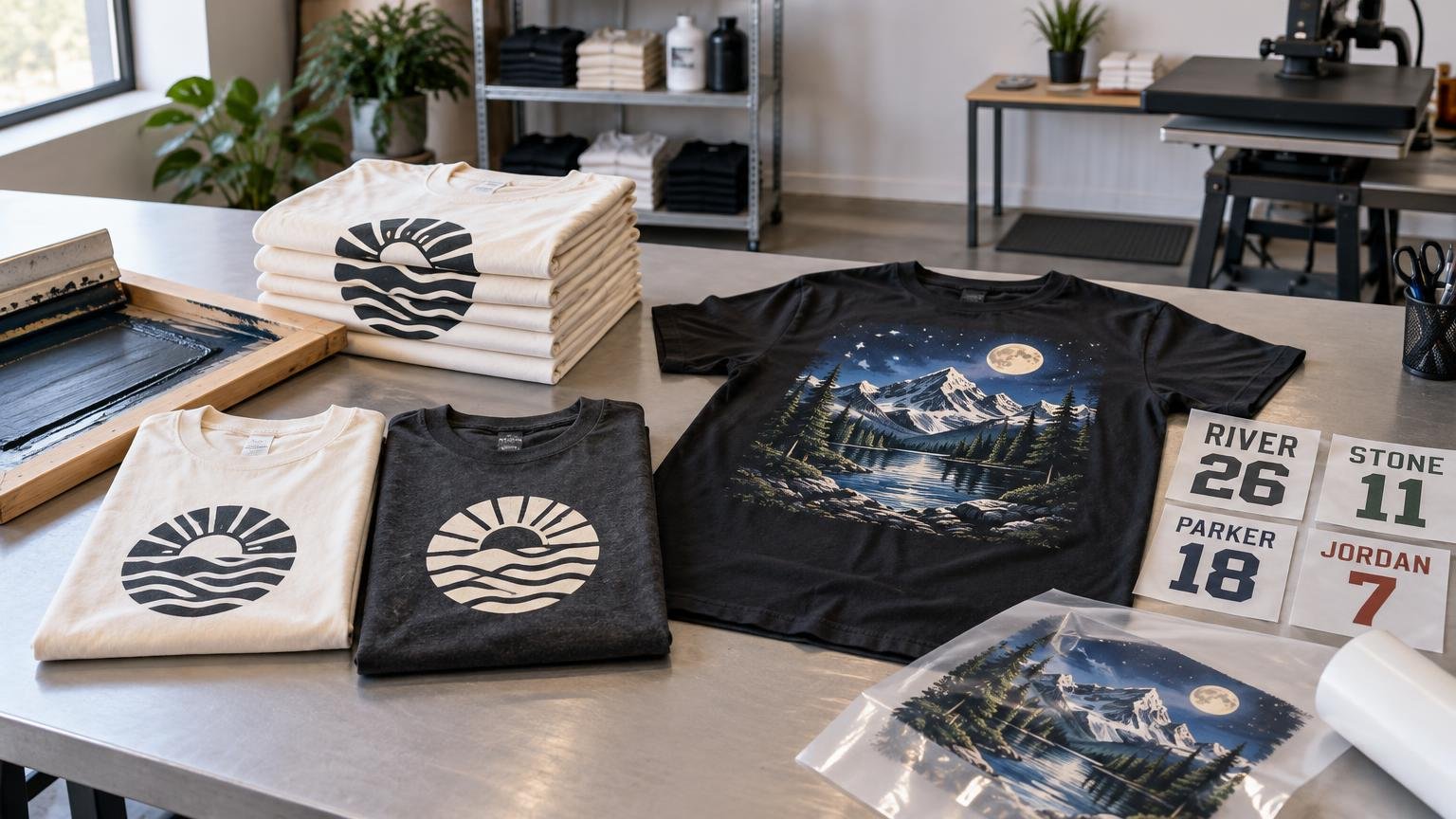
DTF usually deserves the first quote when every garment changes. Examples include employee names beneath a shared logo, player numbers, several colorways in one creator drop, or location-specific text. Screen printing can still handle a common element efficiently, but the variable portion may require a second method or a different production plan.
Ask whether combining methods is practical. A producer might screen print the shared artwork and use transfers for changing names or numbers. The extra handling only makes sense when the resulting cost, appearance, and production control are better than using one method throughout.
Treat polyester as a separate production decision
Do not assume that a method suitable for cotton will behave identically on every polyester or performance garment. Epson states that its DTF system serves a wide range of garment fabrics, while Roland says DTF transfers can be applied to cotton, polyester, and blends. These are system-specific manufacturer statements, not proof that every film, adhesive, ink, press setting, and garment combination is compatible.
Colored polyester can release dye when exposed to heat, potentially discoloring a light-colored graphic. Roland specifically warns about this dye-migration risk and recommends testing because dyes vary by garment brand and fabric type. Screen printing also requires an ink selected for the substrate and production conditions; Wilflex documentation distinguishes ink systems by factors including substrate suitability, cure, hand, and bleed resistance.
For a colored polyester jersey or performance shirt, provide the exact garment model and color before production. Request a decorated sample or controlled test using the intended ink or transfer system. The producer should follow the technical instructions for those materials rather than applying a generic temperature, pressure, cure, or dwell-time rule.
Which method feels softer and lasts longer?
Neither method is universally softer. A small screen-printed mark made with an appropriate ink deposit can feel different from a large, heavily covered print. Likewise, a compact DTF logo can feel different from a full-front transfer with a large area of solid coverage. Artwork coverage, ink or transfer construction, garment weight, and processing choices all affect the result.
Durability also depends on the complete system. Correct curing matters to screen-print ink, while DTF depends on properly produced and applied transfers. Garment selection, dye behavior, stretch, abrasion, laundering, and care can influence long-term performance. Supplier technical instructions should govern cure and application because requirements vary among systems and substrates.
If feel or wash performance is central to the order, do not choose from process labels alone. Obtain comparable samples on the intended garment, preferably with artwork coverage similar to the final design. For a significant order, approve a production sample before releasing the entire run.
Four practical order scenarios
Repeated one-color event shirts
Suppose 300 cotton shirts all receive the same one-color front graphic. Screen printing should be quoted first because one prepared design can be repeated across the run. DTF can still be quoted if the schedule, supplier workflow, or garment handling makes it competitive, but the simplicity and repetition strongly favor evaluating screen printing.
A small photo-style creator release
Suppose 20 shirts use a detailed illustration with gradients and many colors. DTF is a logical first candidate because it can preserve complex color without creating a screen for each conventional spot color. Before approval, inspect detail, color treatment, edge quality, print dimensions, and how the transfer feels at the intended size.
Colored-polyester team jerseys
Suppose a team needs 60 dark polyester shirts with a bright chest graphic. Quantity alone should not decide the method. The garment’s dye stability, the decoration materials, the required heat or cure conditions, and the need for individual numbers all matter. Test the exact garment color and decoration system for migration, discoloration, adhesion, and appearance before authorizing production.
Employee shirts with individual names
Suppose 75 shirts share a company logo but have different employee names. DTF may simplify the changing artwork, while a combined workflow could screen print the shared logo and apply the variable names separately. Compare the complete cost and inspect whether the two decoration types look intentional together.
A 60-second checklist before requesting a quote
- Total garment quantity and quantity for each exact design version
- Garment brand, model, fiber content, weight, and color
- Artwork colors, gradients, fine details, and areas of solid coverage
- Final print dimensions and every print location
- Names, numbers, or text that changes from garment to garment
- Requested finish, special effect, and acceptable print feel
- Needed-in-hands date and delivery location
- Whether a decorated sample or pre-production test is required
Send the original artwork when possible rather than a screenshot. Include fonts or convert approved lettering into vector outlines, and identify any colors that must be matched. If the project later expands beyond apparel into packaging, signage, or other printed pieces, broader custom-printing options may help frame those adjacent production needs.
The practical verdict
Choose screen printing when substantial repetition makes its setup worthwhile, the artwork suits spot-color production, or the design calls for a specific screen-printed effect. Choose DTF when the order is short, visually detailed, full color, highly personalized, or divided among many artwork versions.
Then verify the exceptions. Polyester and performance fabrics require material-specific checks. Feel and durability should be judged from comparable samples, not assumed from the method name. Your next step is to send the artwork, exact garment, quantities by version, print sizes and locations, personalization list, and deadline to the producer. That gives the shop enough information to recommend a method and quote the actual job rather than an imaginary average order.