
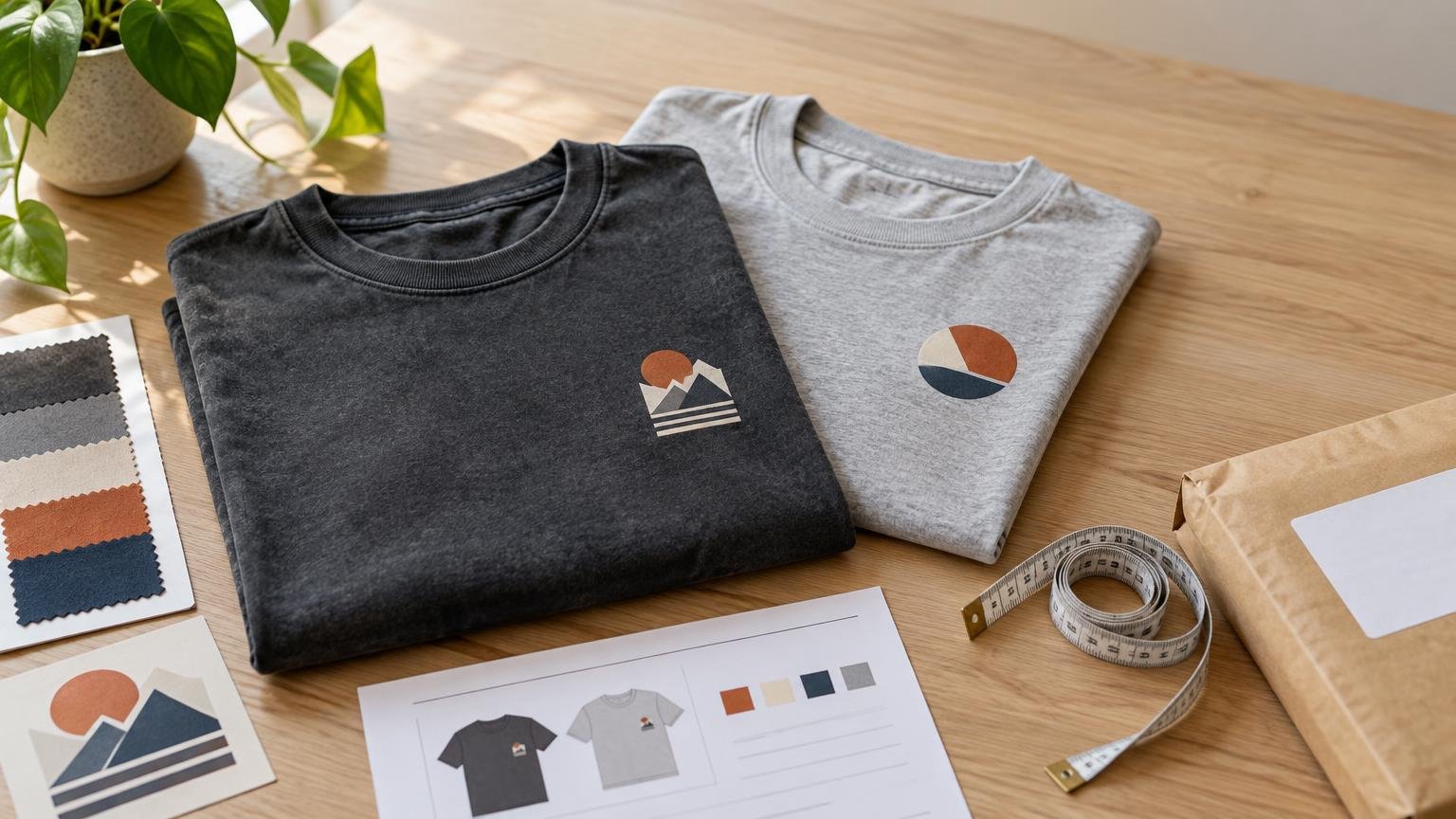
How to Choose an Online T-Shirt Printer: What Matters Beyond Price
Choosing an online T-shirt printer starts with defining the shirt you need, not sorting quotes from lowest to highest. The right supplier must be able to match your artwork to an appropriate garment and decoration method, document what will be produced, and deliver it by the date that matters.
If you are researching how to choose an online T-shirt printer and what matters beyond price, concentrate on production fit and order risk. A low quote loses its advantage if it covers a different blank, excludes artwork preparation, uses an unsuitable method, or leaves too little time to correct a problem before an event.
Start with a job brief before requesting quotes
Send every printer the same job brief. Without one, you may receive prices for materially different products. One quote might use a lightweight promotional blank while another covers a heavier retail-style shirt. One might include two print locations while another assumes one.
Your brief should specify:
- Artwork files or a clear description of artwork still being developed
- Garment color, preferred fabric composition, fit, and approximate weight or quality level
- Quantity by size, including any youth, extended, or specialty sizes
- Each print location and the intended printed dimensions
- Whether names, numbers, or other individual variations are required
- The shirt’s use, such as an event, staff program, merchandise launch, or one-time gift
- The required in-hands date and delivery destination
- Whether you expect to reorder the same design later
Tell the printer which specifications are fixed and where alternatives are acceptable. If the exact blank is flexible but the fabric and fit are not, say so. This lets the printer suggest an available substitute without quietly changing the product you thought you were buying.
Match the decoration method to the job
There is no universal quantity at which one method always becomes cheapest. Artwork, print size, number of locations, garment fabric, setup requirements, personalization, and the printer’s workflow all affect the quote. Use quantity as one input rather than a rigid cutoff.
| Method | Often worth considering for | Questions to ask |
|---|---|---|
| Screen printing | A repeated design across a coordinated run, especially when the artwork can be separated into controlled ink colors | How many colors and locations are included? Are separations, screens, setup, and special inks included? |
| Direct-to-garment (DTG) | Detailed or multicolor artwork on compatible cotton or cotton-blend garments, particularly when setup flexibility matters | Is the selected blank approved for the workflow? Is pretreatment required, and how will the print dimensions be controlled? |
| Direct-to-film (DTF) | Detailed designs, variations, and jobs spanning a wider range of compatible fabrics | What transfer dimensions, adhesive system, and application controls will be used? Can you approve the expected finish and feel? |
| Sublimation | Light-colored polyester apparel where the design should dye the fabric rather than sit as a separate surface layer | Is the fabric sufficiently polyester-rich and suitable for the intended colors? Are seams or garment panels likely to affect placement? |
| Embroidery | Small logos or marks that benefit from a dimensional stitched appearance | Will fine details and small text sew cleanly? What garment structure, backing, and stitch limits apply? |
Epson describes DTG and DTF as different workflows. Its guidance positions DTG for cotton and cotton-polyester blends, while DTF prints onto film, adds adhesive powder, and transfers the design with heat across a wider variety of fabrics. Epson also notes that white-ink DTG workflows require pretreatment. That makes the proposed garment and method a combined decision, not two independent selections.
Screen printing can become attractive when setup is spread across a repeated run, but complex separations, many ink colors, multiple locations, or frequent design variations can change the calculation. For a closer look at that tradeoff, see screen printing versus DTF at different quantities. You can also use this quantity-based guide to choosing T-shirt printers to compare the needs of very small and larger orders without treating its ranges as universal breakpoints.
Polyester requires particular care because not every decoration method produces the same appearance or behaves the same way on every garment. If that fabric is central to the order, compare sublimation and DTF for polyester apparel before approving the production method.
Compare the actual garment, not the mockup
A digital mockup shows the design concept. It does not tell you how heavy, soft, fitted, opaque, stretchy, or consistent the underlying shirt will be. Ask for the blank manufacturer, style number, fabric composition, garment color, available size range, and any relevant fit description.
Use the style number to keep competing quotes comparable. “Premium cotton shirt” is an interpretation; a manufacturer and style number identify a specific product. If the printer proposes a substitute, ask which specifications change and approve the replacement before production.
Size availability also matters. A blank that works for the main size range may switch construction, fabric composition, or color availability in youth or extended sizes. Ask whether every listed size will use the same style and whether any exceptions will be disclosed on the proof or order confirmation.
Treat the artwork and proof as production documents
A useful proof should define what the shop intends to make. It should show the correct artwork version, garment color, print locations, printed width or height, orientation, and any personalization. Review spelling, dates, numbers, transparency effects, and the relationship between the design and garment seams.
Do not approve placement based only on how large a design appears in a generic shirt illustration. Ask for the final dimensions in inches or another stated unit. The same printed width can feel oversized on a small shirt and restrained on a large one, so discuss whether one size will be used across the run or whether the artwork will be scaled for different garment groups. Our guide to choosing a front shirt design size explains how artwork shape and garment size affect that decision.
For screen printing, artwork quality, resolution, color separations, and file format can all affect production preparation, according to PRINTING United Alliance’s screen-print artwork guidance. Ask whether the quote includes file cleanup, vector conversion, separations, redraw work, or font handling. If it does not, request a price for that work before comparing totals.
A proof is still a representation, not a physical sample. Screen colors, garment texture, ink coverage, transfer feel, and actual printed color may not be fully communicated by an on-screen image. Ask the printer what the proof confirms and what it does not.
Use samples and quality controls to reduce risk
A sample is most valuable when a mistake would be expensive or difficult to recover from. Consider requesting one for an unfamiliar blank, a consequential launch, unusual placement, sensitive color expectations, or a method you have not previously approved. Not every printer offers a one-off production sample, and sampling can add cost and time, but it may expose a mismatch before the full run.
If a physical sample is unavailable, ask how the shop controls the job. Useful signals include a documented art approval, identification of the exact blank, stated print dimensions, an order summary showing all locations, and a clear process for reporting defects. These controls do not guarantee perfection, but they make the approved specification easier to verify.
Separate production time, ship date, and in-hands date
“Ready in five days” is incomplete unless you know what becomes ready. Production completion, carrier pickup, estimated delivery, and guaranteed arrival are different milestones. For an event or launch, provide the date and location where the shirts must physically arrive and ask the seller to confirm the applicable commitment in writing.
Leave room for proof approval, payment, garment availability, production, carrier transit, and inspection after delivery. Clarify whether the schedule begins when you submit the order, approve the artwork, or complete payment. If rush service is required, verify whether the fee accelerates production, shipping, or both.
For U.S. shoppers, the FTC’s online-shopping guidance recommends checking the total cost, expected delivery date, and refund terms before buying. It also explains that if a seller cannot ship within the advertised time, the seller must provide a revised shipping date and an opportunity to accept the delay or cancel for a full refund. Customized-order policies can add practical conditions, so read the seller’s current terms rather than assuming every problem receives the same remedy.
Read customized-order policies before paying
Because a personalized order may be difficult to resell, the most important cancellation window may end before printing begins. Check when the order becomes final, whether changes trigger new artwork or setup fees, and what happens if a blank becomes unavailable after payment.
The policy should also explain how to report missing, damaged, or misprinted items. Look for the reporting deadline, required photographs or documentation, and the available remedy. Ask what happens if the delivered print differs materially from the approved artwork, dimensions, location, garment style, or quantity.
Compare total delivered cost
Build a comparison sheet with one row per printer and separate columns for the blank, decoration, service, and delivery charges. The objective is to normalize the quotes before deciding which provides better value.
- Exact blank and any garment upgrade
- Quantity and size-related charges
- Every print or embroidery location
- Artwork cleanup, digitizing, separations, screens, or setup
- Personalized names, numbers, or design variations
- Sample or pre-production approval
- Rush production and expedited shipping
- Taxes and total delivered price
- Replacement or reprint terms if the approved specification is missed
Also account for the cost of failure. An order that arrives after an event, uses the wrong garment, or cannot be reproduced later can cost more than the difference between two quotes. Conversely, do not pay for elaborate controls that add no value to a simple, low-consequence order. Match the level of review to the risk.
If a campaign extends beyond apparel, evaluate broader custom-printing options as a separate workstream. Combining every item under one headline quote can make it harder to see whether the T-shirts themselves are competitively specified.
Plan for a reproducible reorder
Before ordering, ask whether the printer retains the approved artwork and job specifications. Keep your own copy of the production file, proof, blank style and color, decoration method, printed dimensions, placement notes, and order date. Record approved substitutions rather than relying on memory.
A reorder can still vary if the garment, ink or transfer materials, equipment, operator settings, or source artwork changes. Ask the printer to identify any material substitution before rerunning the job. If close matching is important, provide the previous order number and, where practical, a retained physical sample.
One-page online T-shirt printer comparison checklist
- Which decoration method is proposed, and why does it fit this artwork and fabric?
- What exact blank manufacturer, style, composition, color, and size range are included?
- Are any sizes or colors supplied in a different garment style?
- What artwork preparation and setup work are included in the quote?
- Will the proof state the final print dimensions and every location?
- Can the printer supply a physical sample or another pre-production approval option?
- What starts the production clock, and what is the confirmed in-hands date?
- What are the cancellation and change deadlines?
- How must shortages, damage, or production errors be reported?
- What remedy applies if the order materially differs from the approved specification?
- What is the total delivered cost, including rush service, shipping, and taxes?
- Which files and production details will be available for a future reorder?
Choose the best-documented fit, not merely the cheapest quote
The strongest online T-shirt printer is the one that can explain how your design, garment, quantity, and deadline fit its production process. Compare exact blanks, method assumptions, proofs, delivery commitments, and remedies on the same page as price.
Start by writing a complete job brief and sending it unchanged to each candidate. Normalize the responses, resolve every substitution or exclusion, and approve measurable specifications rather than general descriptions. That approach turns a cheap-looking quote into a decision you can evaluate—and makes a successful order much easier to reproduce.
Frequently Asked Questions
What should I compare besides price when choosing an online T-shirt printer?
Compare the exact garment, decoration method, artwork and setup services, proofing process, delivery commitment, customized-order policies, total delivered cost, and support for future reorders.
How should I choose a decoration method?
Match the method to the artwork, fabric, print locations, personalization needs, and supplier workflow. Epson describes DTG and DTF as distinct processes and notes that white-ink DTG requires pretreatment, so the garment and method should be evaluated together.
What garment details should a quote identify?
Ask for the blank manufacturer, style number, fabric composition, color, fit information, available size range, and any differences affecting youth, extended, or specialty sizes.
What should a useful digital proof show?
It should identify the correct artwork version, garment color, print locations, final printed dimensions, orientation, and any personalized names or numbers.
What artwork preparation might affect the final quote?
Ask whether file cleanup, vector conversion, redraw work, font handling, color separations, screens, or other setup is included. Artwork quality, resolution, separations, and file format can affect screen-print preparation.
Should I request a physical sample?
Consider one when the blank or method is unfamiliar, placement or color expectations are sensitive, or a mistake would be difficult to recover from. Confirm whether sampling is available and how it affects cost and timing.
Which delivery date should I rely on?
Use the confirmed in-hands date—the date the shirts must physically arrive—rather than relying only on production completion or carrier pickup. Before buying, check the total cost, expected delivery date, and refund terms.
How can I make a future reorder easier to reproduce?
Keep the production artwork, approved proof, blank style and color, decoration method, print dimensions, placement notes, order date, and any approved substitutions. Ask the printer to disclose material substitutions before rerunning the job.